The value of Shiitake begins with a correctly identified mushroom and carefully controlled raw material. Below, we distinguish its traditional history, natural compound profile and the measurable properties of our extract.
01Name, origin and history
Shiitake has been known in East Asia for centuries as an edible, wood-growing mushroom. The Japanese name traditionally refers to the shii tree and to growing on wood. The mushroom also has a long history in China as a food and cultivated natural product.
For a long time, the mushroom was cultivated on hardwood logs. Later, controlled growing methods using pasteurised or sterilised woody substrates became available. Shiitake thus became one of the best-known cultivated edible mushrooms in the world.
02How Shiitake grows
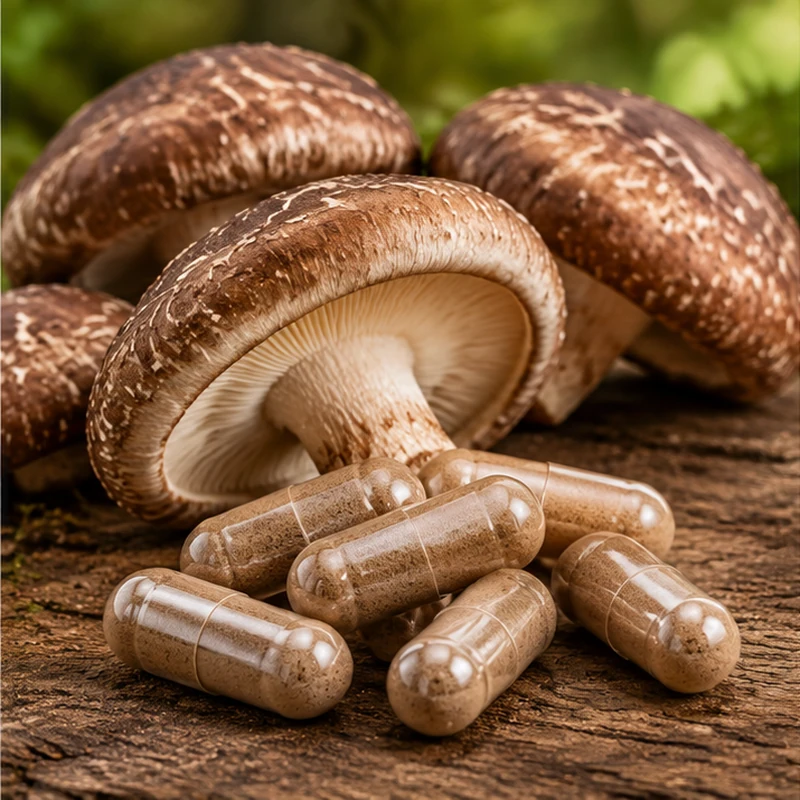
The fruiting body usually has a brown cap, often with pale scales or cracks, a firm stem and light-coloured gills underneath. In nature, the fungus lives on dead or decaying hardwood and breaks down components of the wood.
During cultivation, the substrate, temperature, humidity and stage of development affect both yield and natural composition. The fruiting body is the part from which our Shiitake extract is produced.
03The natural compound profile
Shiitake naturally contains a diverse mixture of polysaccharides, glucans, proteins, amino acids, fibre-like substances and sterols. Research into Shiitake also examines compounds including lentinan, eritadenine and ergosterol described.
The presence of a substance in the mushroom does not mean that it occurs in the same quantity in every extract. The final composition depends, among other things, on the raw material and the extraction method.
04What is lentinan?
Lentinan is a specific branched beta-glucan fraction from Shiitake that has been studied scientifically. It is not the same as the total polysaccharide content and should not be used as a synonym for it.
Some research preparations contain purified or separately administered lentinan. These preparations differ fundamentally from a dietary supplement containing standardised Shiitake extract in capsules.
05From mushroom to extract
Extraction releases some of the compounds from processed fungal tissue. Water extraction is used in mycology to obtain certain soluble polysaccharides; other processing techniques may produce different compound profiles.
An extract therefore does not automatically have the same composition as a dried mushroom. The precise processing steps and extraction ratio are product-specific details that must be supported by technical documentation.
06What does 30% polysaccharides mean?
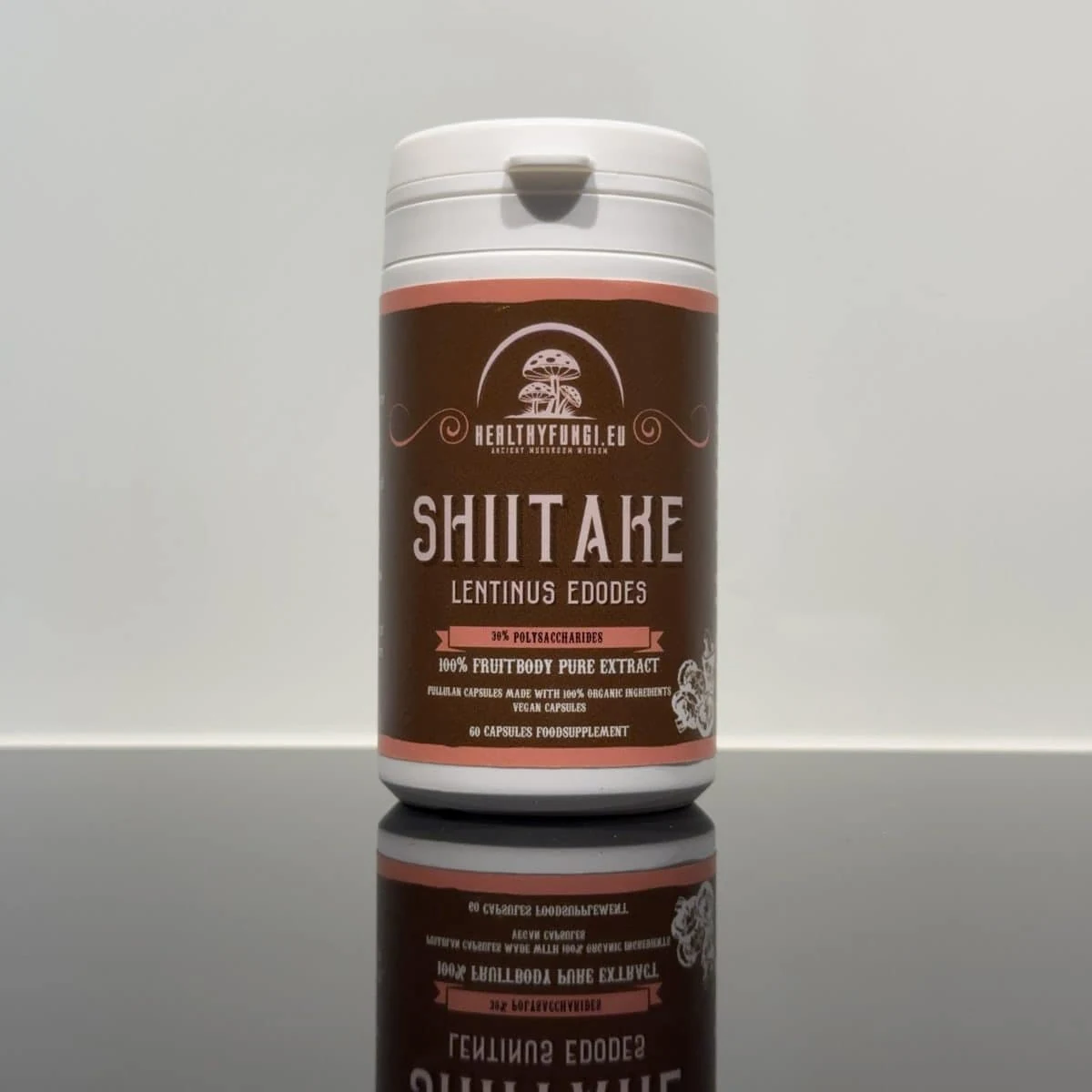
Our Shiitake extract is standardized to at least 30% polysaccharides. This describes the concentration of a group of carbohydrate compounds determined by analysis.
That percentage is not a separate determination of beta-glucans or lentinan. A higher measured polysaccharide content does not, in itself, demonstrate a therapeutic effect either.
Pure extract in a plant-based capsule
Healthy Fungi Shiitake is offered as a fruiting-body extract, packaged in pullulan capsules made from organic tapioca, without HPMC. According to our product information, the raw materials are tested by an independent German laboratory before processing, and no irradiation is used during production. The product information specifies 60 capsules per jar.