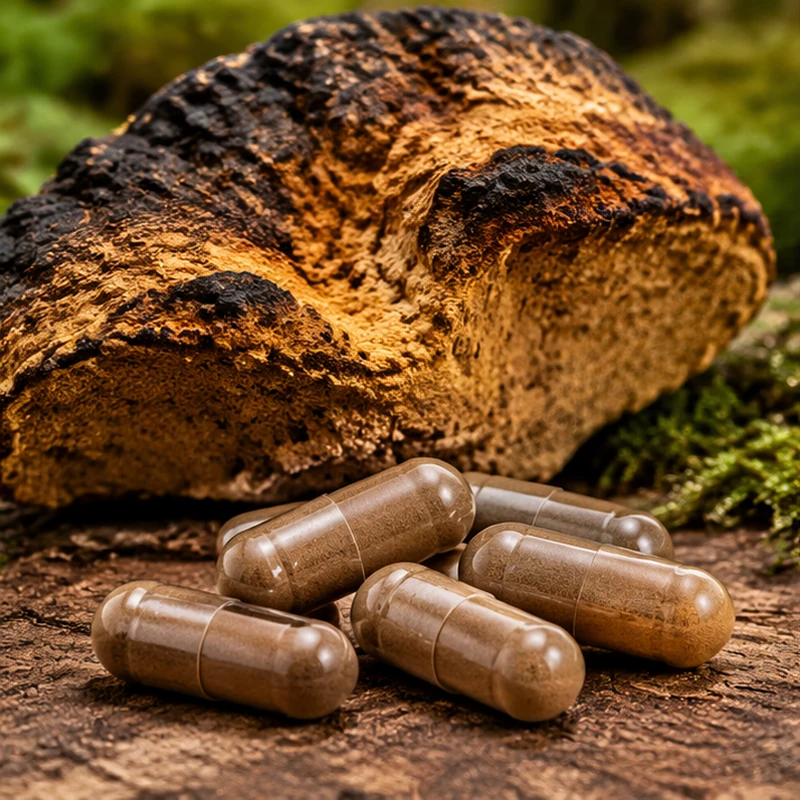
Sanghwang has a distinctive woody fruiting body, a rich place in East Asian tradition and a complex history of scientific names. In our product information, we distinguish the origins of its traditional use, the natural compounds in the extract and the results of modern research.
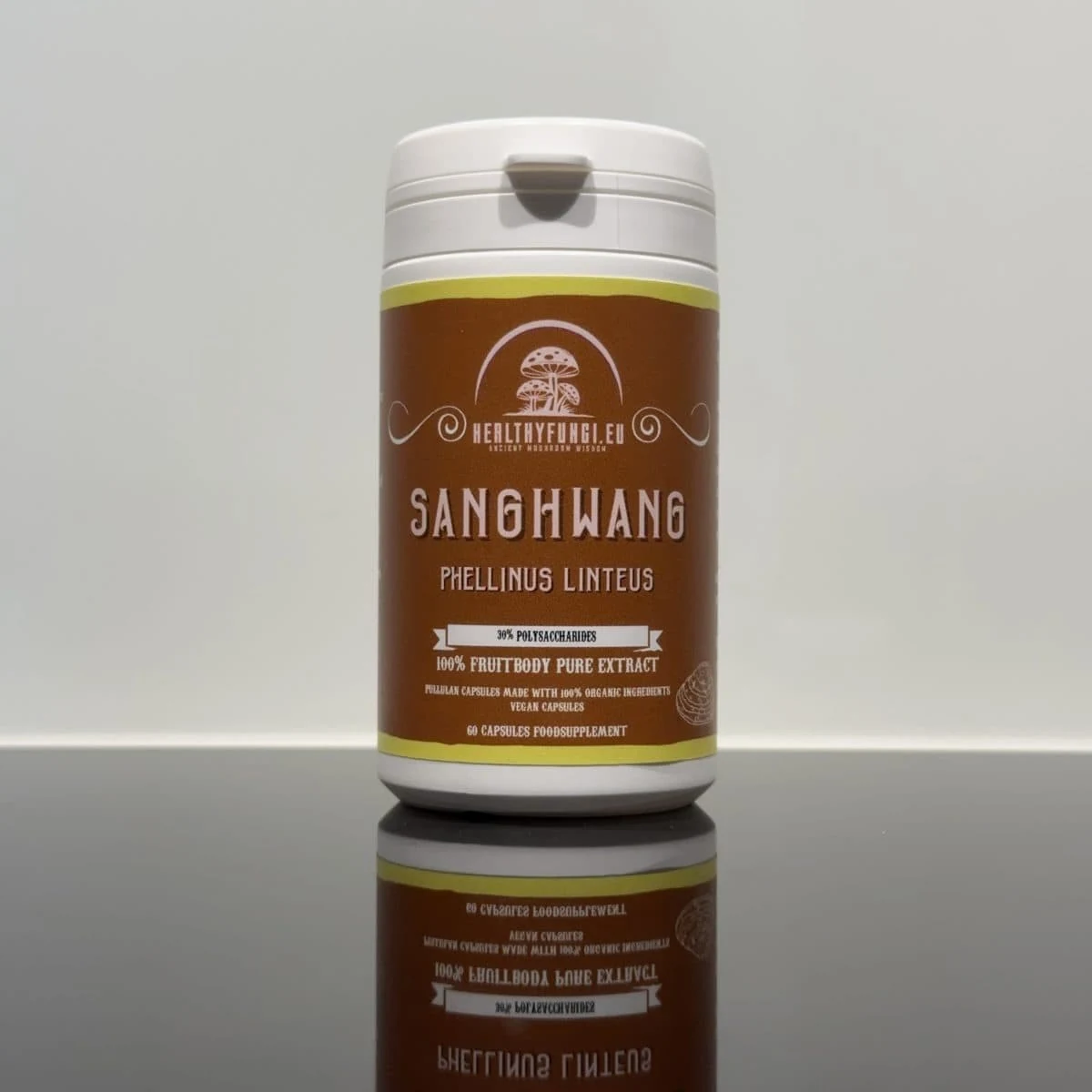
Name on our productPhellinus linteus
Part of mushroom usedFruiting body
StandardizationAt least 30% polysaccharides
01The history of Sanghwang
The name Sanghwang is associated with traditional Chinese and Korean mushroom knowledge. Wood-decaying fungi in this group appear in historical descriptions of natural products and have become known by different names in different regions. The traditional name does not always designate a single biological species.
In Korea, the term commonly used is Sanghwang-beoseot. In China, the name Sanghuang used. The cultural history of these names is broader than the modern taxonomic classification of the genus.
02How these wood-decaying fungi grow
Fungi related to Sanghwang grow on hardwood and form firm, often perennial fruiting bodies. Their exterior is brown to rust-coloured and can become increasingly hard and thick over time. The visible fruiting body consists of a compact fungal structure and differs greatly from the soft cap of a typical edible mushroom.
Some Sanghwang species are associated with specific tree species, including mulberry. The host tree depends on the exact fungal species. A host tree mentioned in a scientific study should therefore not automatically be attributed to every raw material called Sanghwang.
03Phellinus and Sanghuangporus: why the name matters
The designation Phellinus linteus was widely used in older publications. Modern DNA research has shown that material bearing this name often consisted of several closely related species. Today, among other classifications, the separate genus Sanghuangporus distinguished, with species such as S. sanghuang, S. baumii and S. vaninii.
We retain the species name from our existing product specification. We do not automatically treat a publication about another Sanghwang species as research on precisely the same extract. The origin and species identification of the raw material are decisive for establishing an exact match.
04A rich natural compound profile
Scientific studies of fungi in this group describe polysaccharides, glucans, polyphenols and pigment-like compounds, among other substances. Some species also contain small molecules belonging to the styrylpyrone group and other secondary metabolites.
The presence and amounts of these compounds vary with the species, mushroom parts used and processing. It is therefore important to distinguish the fungus's natural chemical profile from what has actually been measured in a finished extract.
05From wood-decaying fungus to extract
Because the fruiting body is compact and woody, the dried raw material is first broken into smaller pieces for extraction. Hot water can release certain soluble polysaccharides from the fungal tissue. Other solvents or extraction methods yield partly different compounds.
An extract is therefore not identical to ground mushroom material. The exact extraction method and any ratio between raw material and finished product are established from the technical documentation for the relevant batch, not inferred from its appearance or name.
06What does at least 30% polysaccharides mean?
Our Sanghwang extract is standardized to at least 30% polysaccharides. This concentration refers to the specified group of carbohydrate compounds measured during analysis.
The percentage is no separate specification of the beta-glucan content and does not indicate the concentration of individual phenolic compounds. Other analyses are required for that. Standardisation is a chemical product specification, not evidence of a medical effect.
From raw material to capsule
Healthy Fungi supplies Sanghwang as an extract of the fruiting body. The product information specifies a plant-based pullulan capsule shell made from organic tapioca, without HPMC. Before processing, the raw materials are tested by an independent German laboratory; no irradiation is used during production. Each jar contains 60 capsules packaged.