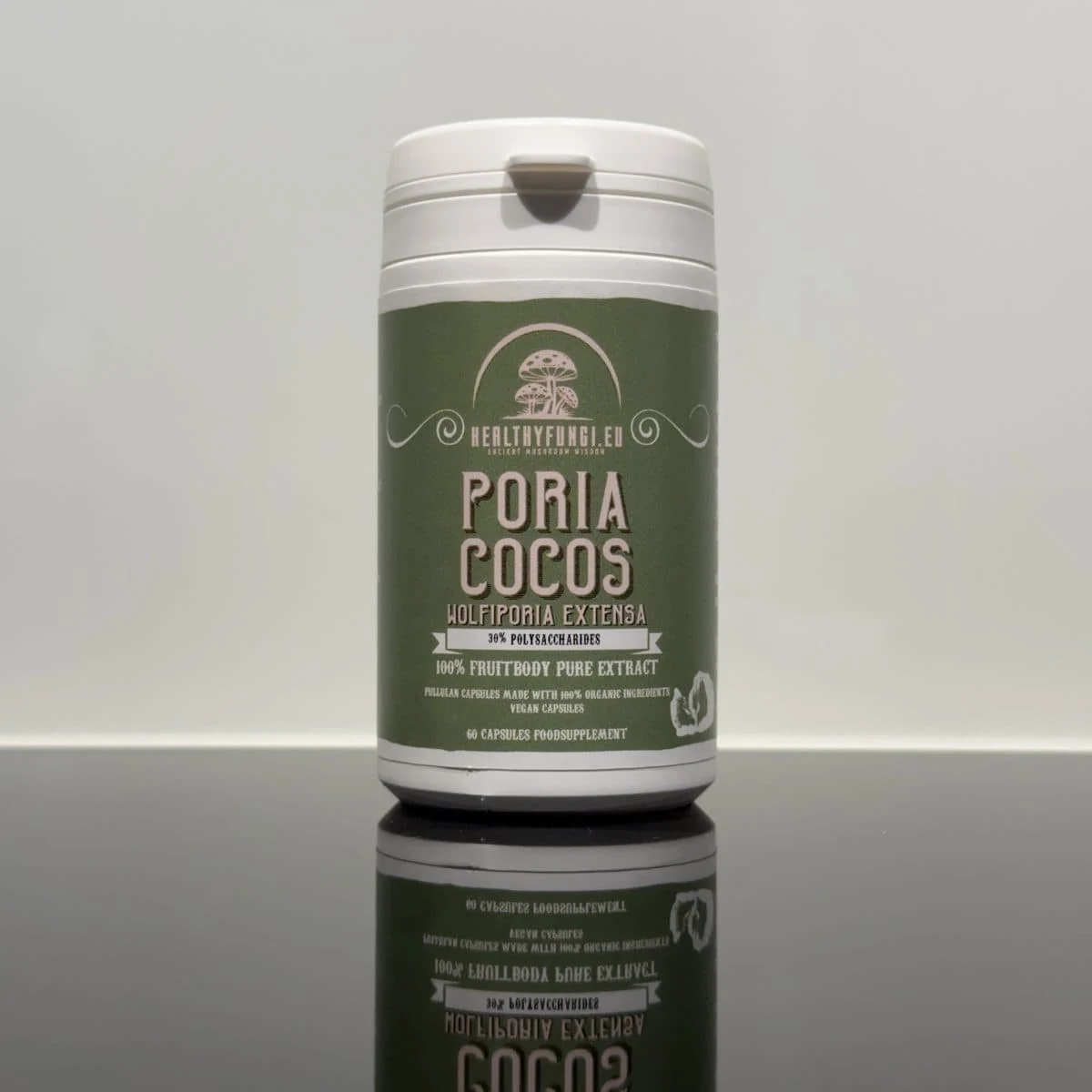
Botanical nameWolfiporia extensa
Part traditionally usedUnderground sclerotium
Our product specificationAt least 30% polysaccharides
01The identity of Poria
The name Poria cocos has become established historically. Mycological and pharmaceutical publications also use the names Wolfiporia cocos and Wolfiporia extensa occurs. For product identification, the combination of species name, fungal structure used and origin matters more than an old trade name alone.
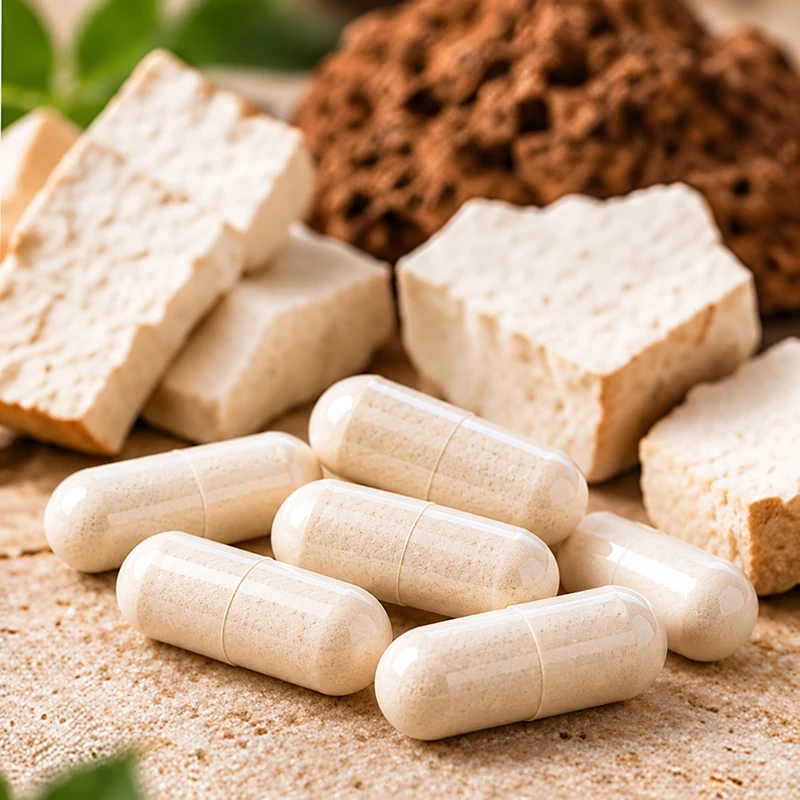
The sclerotium is a hard, often irregularly rounded mass. Its exterior is brown and rough; the inside consists of compact, lighter fungal tissue. It is not a tuber or a root of the pine tree, but a structure formed by the fungus itself.
02Growth, raw material and cultivation
Poria develops primarily in association with dead or weakened pine wood and pine roots. Underground sclerotia can grow to considerable sizes and are cleaned, sliced and dried after harvesting. Growing conditions and time to harvest affect the raw material.
Controlled cultivation is also possible. For a reliable finished product, we look at correct species identification, the parts used, batch traceability, moisture content and testing for unwanted contaminants.
03Fu Ling in East Asian tradition
Fu Ling has been known in Chinese materia medica for many centuries. In traditional Chinese medicine, the raw material is associated, among other things, with the concept of moisture and with supporting digestive function within the framework of traditional Chinese medicine. These concepts belong to a historical explanatory model and are not established medical effects of a modern supplement.
The fungus is also used in Japan under the name hoelen. It occurs in various classical herbal combinations; the composition and intended use of such formulas differ from those of a single standardised Poria extract.
04The natural compound profile
Various polysaccharides have been described in the sclerotium, particularly glucan-rich compounds. The fungus also contains characteristic lanostane-type triterpenes, such as pachymic acid and various poricoic acids. Sterols and other compounds are also present.
The presence of these substances in the species does not mean that they occur in the same proportions in every extract. The raw material, solvents and temperature determine which fractions ultimately enter a preparation.
05From sclerotium to extract
In a commonly used preparation process, the dried raw material is broken into smaller pieces and extracted with hot water. The water-soluble constituents can then be concentrated and dried into a powder. Other extraction methods yield partly different fractions; in particular, not all triterpenes behave in the same way as water-soluble polysaccharides.
We therefore regard an extract and simply ground Poria as two different preparations. The exact method used for a particular product batch must be documented in its technical specifications; we do not infer it from the colour of the powder.
06What does at least 30% mean?
Our Poria cocos product specification states at least 30% polysaccharides. This is the stated concentration of the total measured polysaccharide fraction in the extract, not a percentage describing every individual active compound.
The figure alone says not how much beta-glucan, pachymic acid or poricoic acid is present. These levels require separate analytical methods. A higher polysaccharide content also does not automatically mean a better or clinically more effective extract.
The different parts of the sclerotium
Traditional Chinese raw-material practice distinguishes between different parts and preparations of Fu Ling, such as the pale inner tissue and outer peel. These materials do not always have the same composition or traditional application. When assessing a modern extract, what matters is therefore which part was actually processed and how each batch's composition is checked.