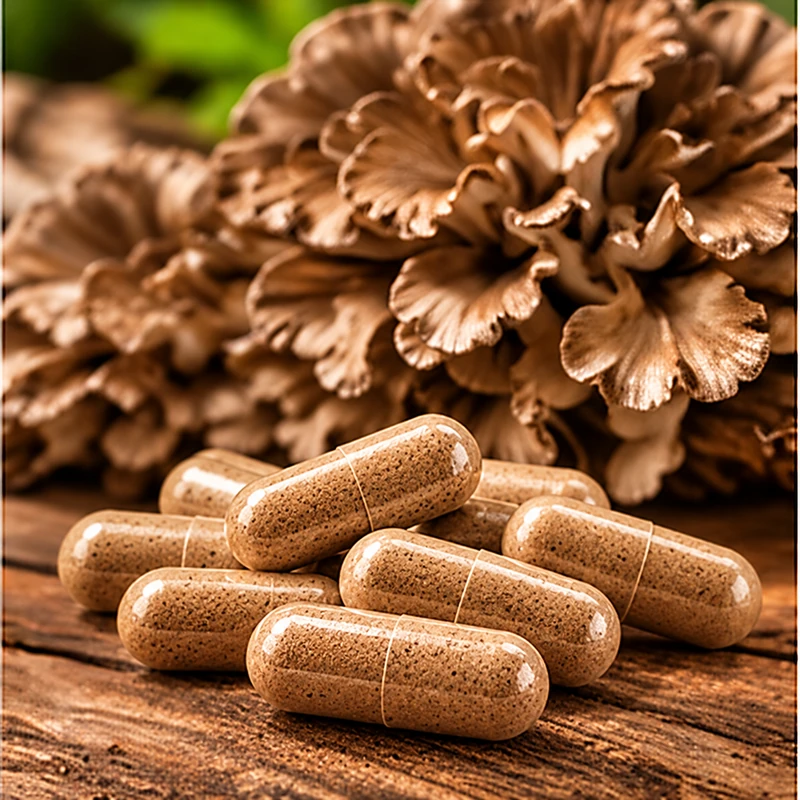
Maitake is an edible wood-dwelling fungus with a striking rosette of overlapping grey-brown fans. The quality of a Maitake extract starts with the correct species identification and the fruiting body used. Processing, standardization and inspection of the finished preparation then determine the product's chemical profile.
01A recognizable mushroom
Grifola frondosa belongs to the family Meripilaceae. Its Dutch common name hen of the woods refers to its growing habitat and the branching form of its fruiting body. In English-speaking countries, Maitake is also hen of the woods called.
Numerous small, rounded to fan-shaped caps grow from a shared base. Their undersides have pores rather than gills. The exterior varies from grey-brown to brown, while the interior is pale.
02Growth and cultivation
Maitake grows mainly near the roots and trunks of old deciduous trees, especially oaks. The species occurs in temperate regions of Europe, Asia and North America. In the wild, fruiting bodies usually appear in late summer and autumn.
Maitake is also grown under controlled conditions to provide a consistent raw material, including on wood-based substrates. Growing conditions, maturity and processing can affect the proportions of the substances present.
03Cuisine and tradition
In Japan, Maitake is prized for its firm, aromatic fruiting body and distinctive umami flavor. Its name is often translated as dancing mushroom; according to a well-known tradition, those who found valuable wild Maitake danced with joy.
In Japanese and Chinese food cultures, the mushroom is used in soups, rice dishes and stir-fried preparations. This culinary tradition is separate from the question of which effects of concentrated supplements have been clinically proven.
04The natural compound profile
Maitake contains various polysaccharides, including beta-glucans with varying branching patterns. The fruiting body also contains proteins, amino acids, fiber components, sterols such as ergosterol, and minerals.
The final composition of an extract is not identical to that of a fresh or dried fruiting body. Which fractions are present in the finished product depends on the extraction steps chosen and the analytical method.
05From fruiting body to extract
During mushroom processing, water-soluble substances can be extracted from dried, chopped fruiting bodies using hot water. Concentration and drying produce an extract powder. Other techniques may yield different fractions; an extract is therefore not the same as simply ground mushroom powder.
When assessing our Maitake product, we focus on its stated composition, the identity of the fruiting body and its purity. The method and actual content must correspond to the product specifications for the batch concerned.
06What do 50% and 20% mean?
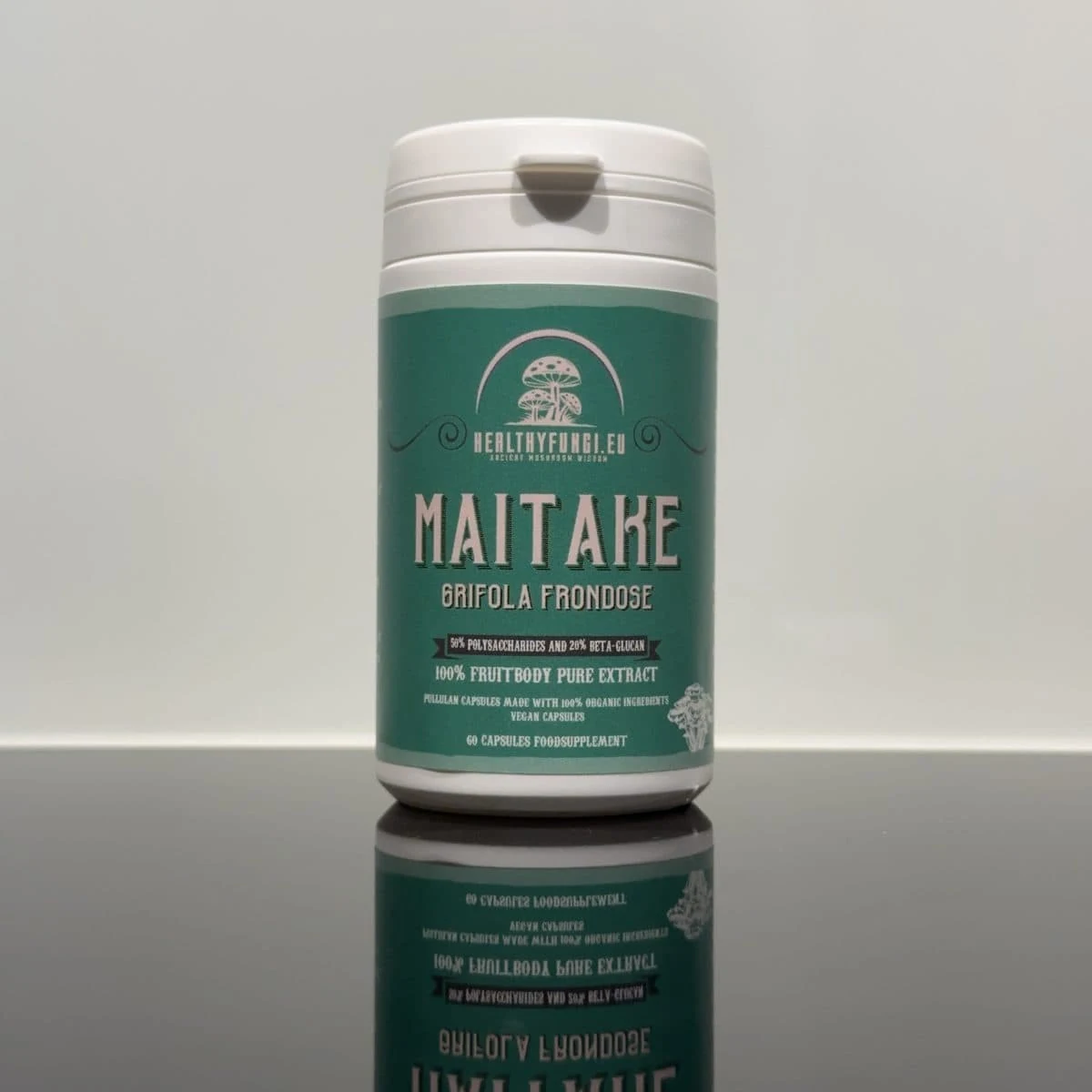
Our extract has a minimum specification of 50% total polysaccharides and 20% beta-glucans. Beta-glucans make up part of the total polysaccharides: these percentages are therefore not two separate portions that may be added together to make 70%.
The measurement method matters. Measuring all polysaccharides does not automatically reveal how much of that total consists of beta-glucans; a suitable separate analysis is required. Concentration alone does not demonstrate a therapeutic effect.
The D-fraction is not the same as a beta-glucan percentage
Scientific publications on Maitake refer to the so-called D-fraction for: a specific, further separated polysaccharide fraction studied under controlled conditions. The related MD-fraction is also described. A specification of '50% polysaccharides, 20% beta-glucans' does not mean that an extract automatically contains a known quantity of the D- or MD-fraction. Without a separate analysis, we do not state a content for these fractions.