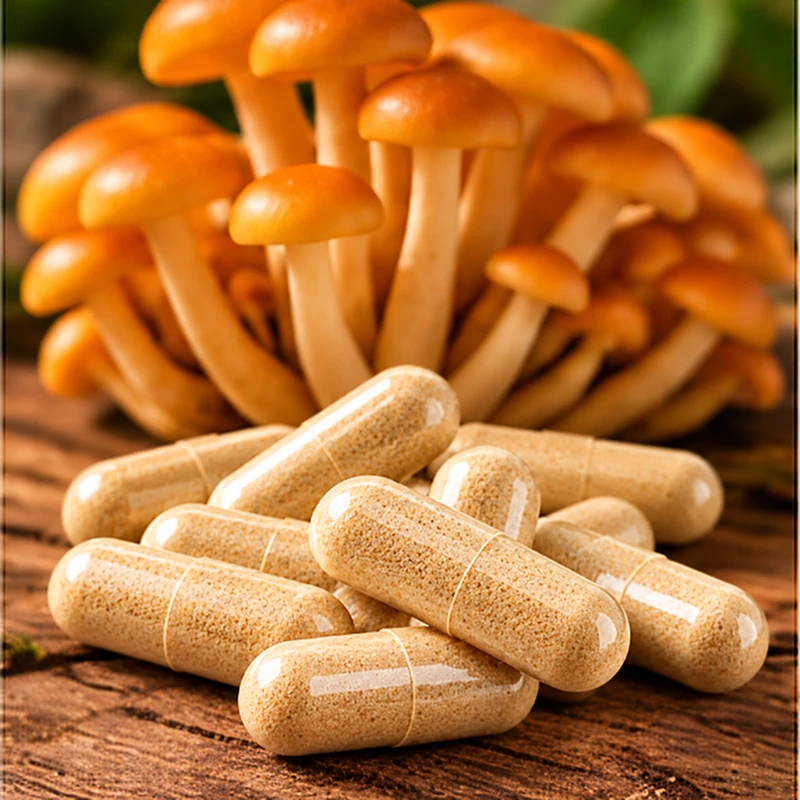
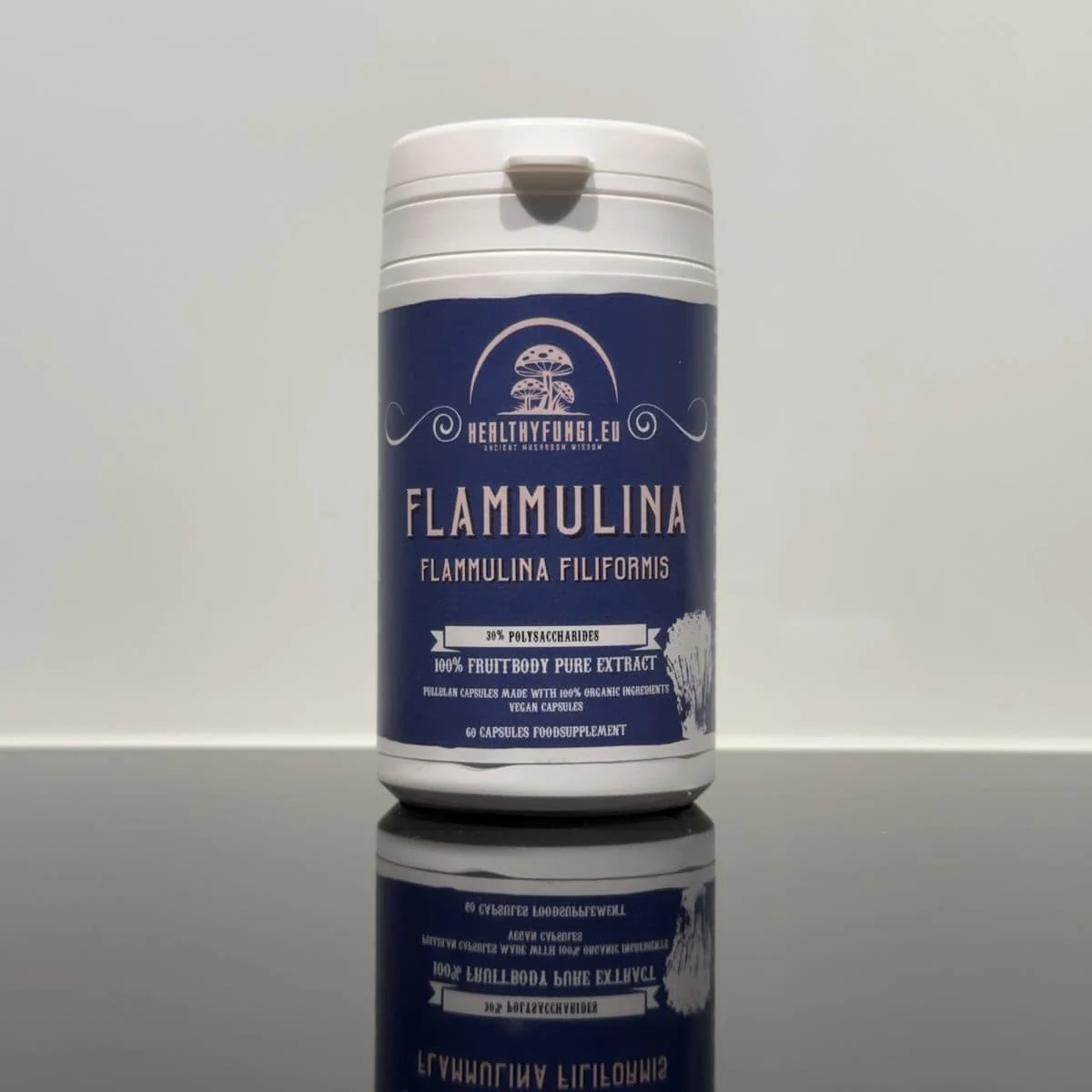
Flammulina is among East Asia's best-known edible wood-growing mushrooms. For the extract, we distinguish between the properties of the mushroom itself, the composition of the fruiting bodies used and what is ultimately standardized in the capsule.
Materials usedFruiting body
ExtractAt least 30% polysaccharides
Dosage formPlant-based pullulan capsules
01The winter mushroom
In the wild, velvet shank often appears during cold months on dead or weakened hardwood trees. It grows in clusters, with golden-yellow to orange-brown caps and a dark, finely hairy lower stem. This is the origin of F. velutipes its name.
Under controlled cultivation, the shape, color and length of the fruiting bodies may differ from those of the wild winter mushroom. The species used and cultivation conditions are therefore important details for traceability.
02Centuries of culinary use
Flammulina has long been valued as an edible mushroom in China, Japan and Korea. It is used in broths, hot dishes and other preparations. Growers developed both wood-based cultivation and modern controlled growing methods.
Old stories associate unusual mushrooms with pharaohs and immortality, but there is no reliable botanical evidence that these accounts referred specifically to Flammulina. Its well-documented history of use is primarily in East Asia.
03Cultivation and raw materials
Our Flammulina is grown using woody materials, including oak and elm. We use the fruiting body to prepare the extract. This distinguishes preparations made from mature mushrooms from products consisting solely of mycelium or ground-up cultivation substrate.
Good raw material is carefully identified, harvested, dried and protected from microbiological contamination. The quality of the final extract also depends on processing and analysis of every production batch.
04Natural constituents
Flammulina contains various polysaccharides, including glucans, as well as proteins, amino acids, dietary fiber, sterols and minerals. Specific Flammulina proteins, including FIP-fve, have also been described in scientific research.
The composition of a whole fruiting body is not identical to that of an extract. Some water-soluble compounds are concentrated during extraction, while other constituents partly remain behind or change during processing.
05What does 30% polysaccharides mean?
Our extract is specified to contain at least 30% total polysaccharides. This percentage refers to a group of carbohydrate compounds. It does not mean that the extract contains 30% beta-glucans. Beta-glucans are only one possible subgroup.
Separate measurement methods are needed to distinguish different types of glucans. Quality analysis must also account for any starch or other carbohydrates from the raw material and processing steps.
06Extraction and product testing
Hot-water extraction is a commonly used method for obtaining water-soluble polysaccharide fractions from fungi. Separation, concentration and drying can yield a stable extract powder. The precise outcome depends on temperature, time and raw material.
Our assessment focuses on species identity, the parts of the mushroom used, polysaccharide content, and microbiological and chemical purity. A high content alone is not a measure of clinical efficacy.
Identity and origin of the raw material
At Healthy Fungi, accurate species identification is essential. The scientific name Flammulina velutipes refers to velvet shank. A traceable extract requires information on cultivation origin, the fruiting bodies used and production records.