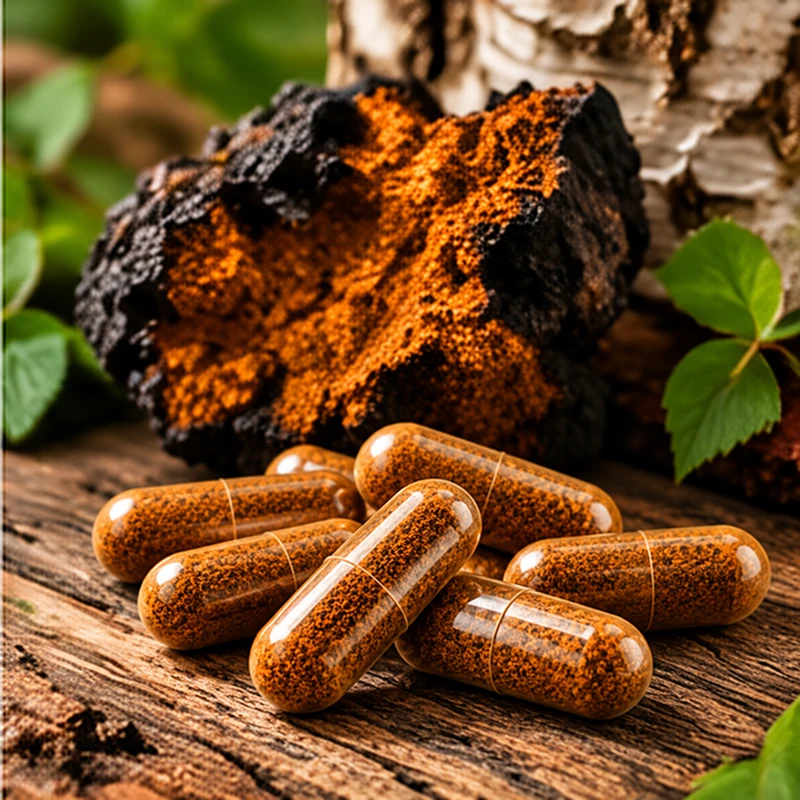
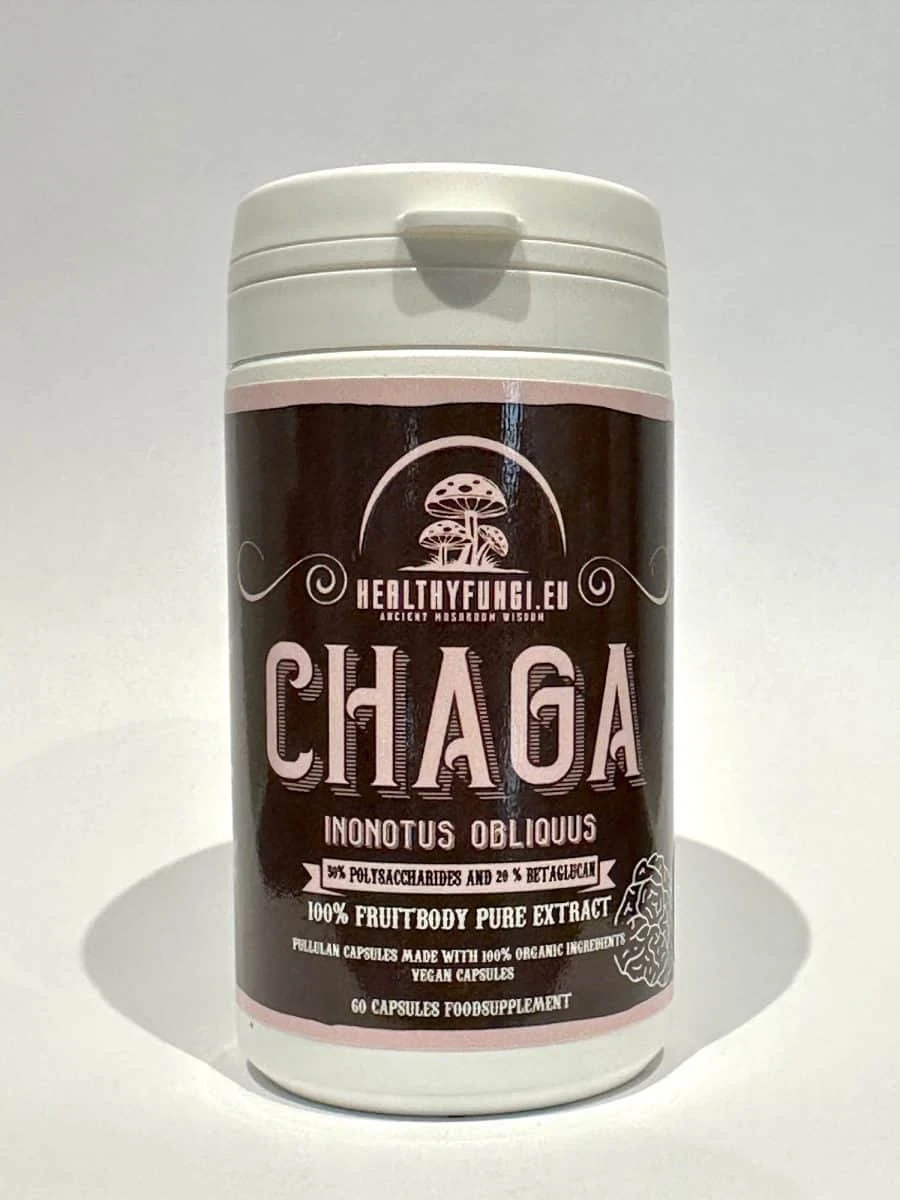
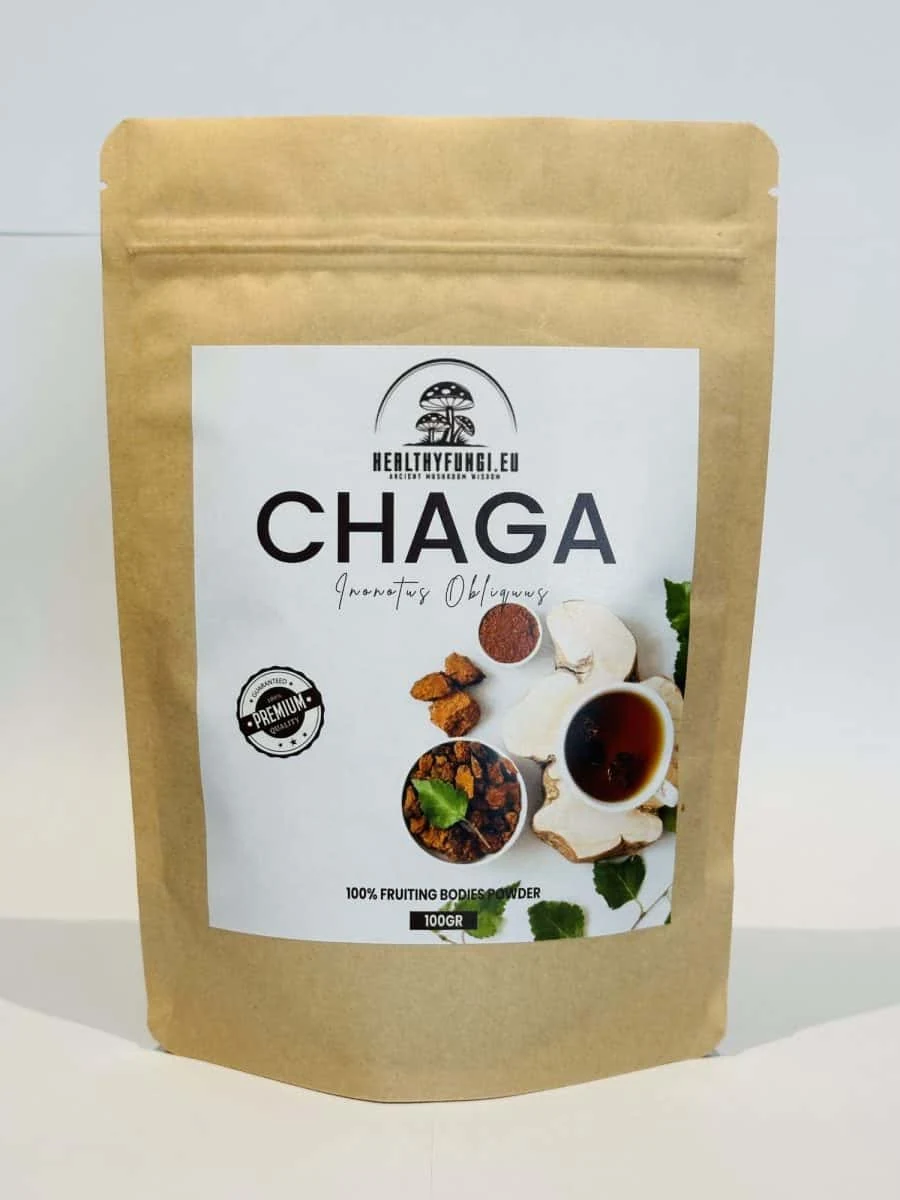
Chaga is recognizable by its black, almost charred exterior and rust-brown core. The mushroom has a special place in Northern European and Russian foraging traditions. For our preparations, we focus on the correct species, origin, composition and careful processing.
SpeciesInonotus obliquus · birch-associated Chaga
Extract50% polysaccharides · 20% beta-glucans
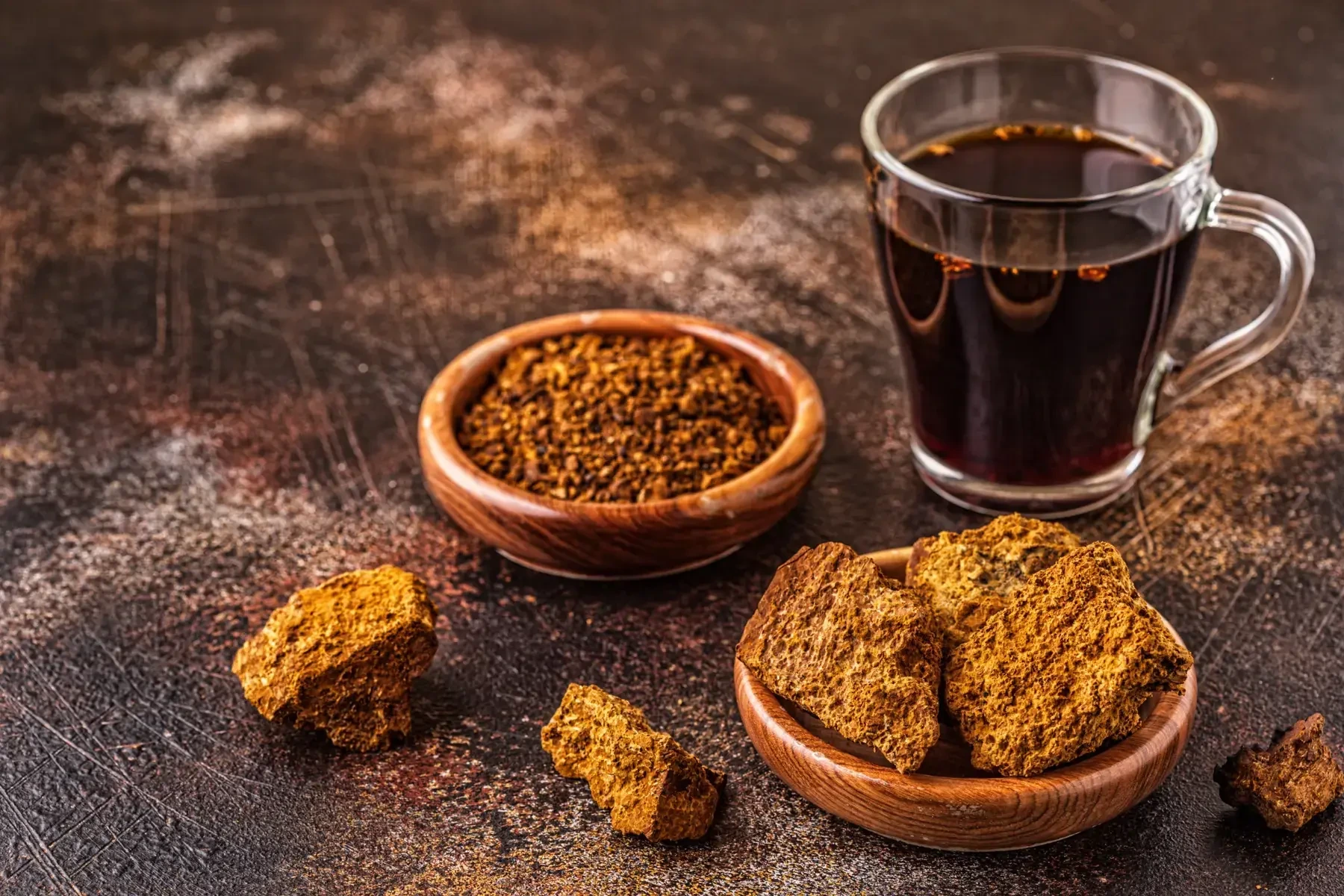
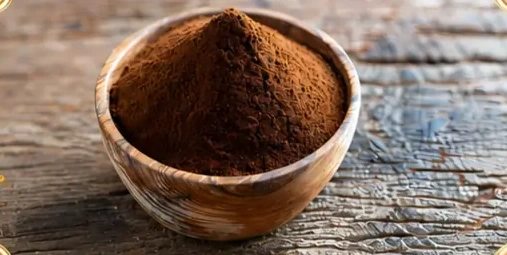
Available formsExtract capsules and pure Chaga powder
01The mushroom on the birch tree
Chaga grows mainly on living birch trees in cold and temperate forests. The visible, irregular black growth consists of a sterile fungal mass that may be intertwined with birch wood. It is therefore not the same as the ordinary, spore-producing fruiting body.
The hard exterior has deep cracks; the inside is brown to orange-brown. The tree of origin and harvested material are important for identifying the raw material.
02Russian tradition and Maslennikov
In Siberia, including among the Khanty people, Chaga forms part of a long tradition of dark infusions. The practices of gathering, drying and steeping Chaga have been passed down through generations.
The Russian physician Sergei Nikitich Maslennikov (1887–1958) is closely associated with the tradition surrounding Chaga. According to historical accounts, he investigated the use of Chaga among farmers in and around Aleksandrov and described various preparation methods. Cancer Ward. That historical use does not constitute evidence for treating diseases.
03Raw materials and processing
We use Chaga material formed on birch trees. For the extract, the material is processed and concentrated; Chaga powder consists of finely ground raw material. These products are therefore not interchangeable simply on the basis of weight.
Hot-water extraction mainly targets water-soluble constituents. Other solvents, including ethanol, may extract different fractions. The method used and the accompanying analyses determine which compounds can be identified in the final product.
04What does Chaga naturally contain?
Chaga contains a variety of polysaccharides, including certain glucan fractions, melanin-like pigments, phenolic compounds, sterols and triterpenoids. Compounds studied in Chaga research include inotodiol and betulin-related substances.
Not every constituent occurs at the same concentration in all raw materials or extracts. Some substances are more soluble in water; others are better isolated with ethanol. A high total polysaccharide percentage alone says nothing about a clinically proven effect.
05What does the standardization mean?
Our Chaga extract has a minimum product specification of 50% total polysaccharides and at least 20% beta-glucans. These are two separate parameters: beta-glucans are a subgroup of polysaccharides.
Each capsule is specified to contain 300–350 mg of extract, with 60 capsules per jar. That corresponds to approximately 18–21 grams of extract per package. The percentages are product specifications; laboratory analyses are important for confirmation of each production batch.
06Purity and product quality
For Chaga, we assess the correct species, origin, raw material used, moisture content, microbiological quality and possible contaminants. Testing for heavy metals and oxalates is also relevant, especially when powder is used regularly.
The exact composition and values may differ by product and batch. The current product label and relevant analysis therefore take precedence for allergens, additives used and declared concentrations.