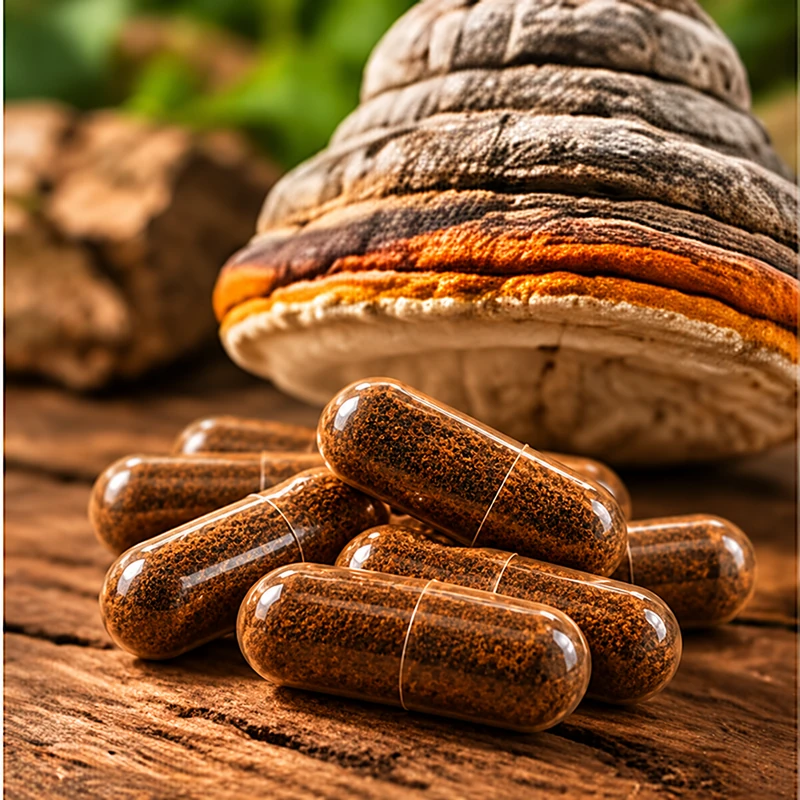
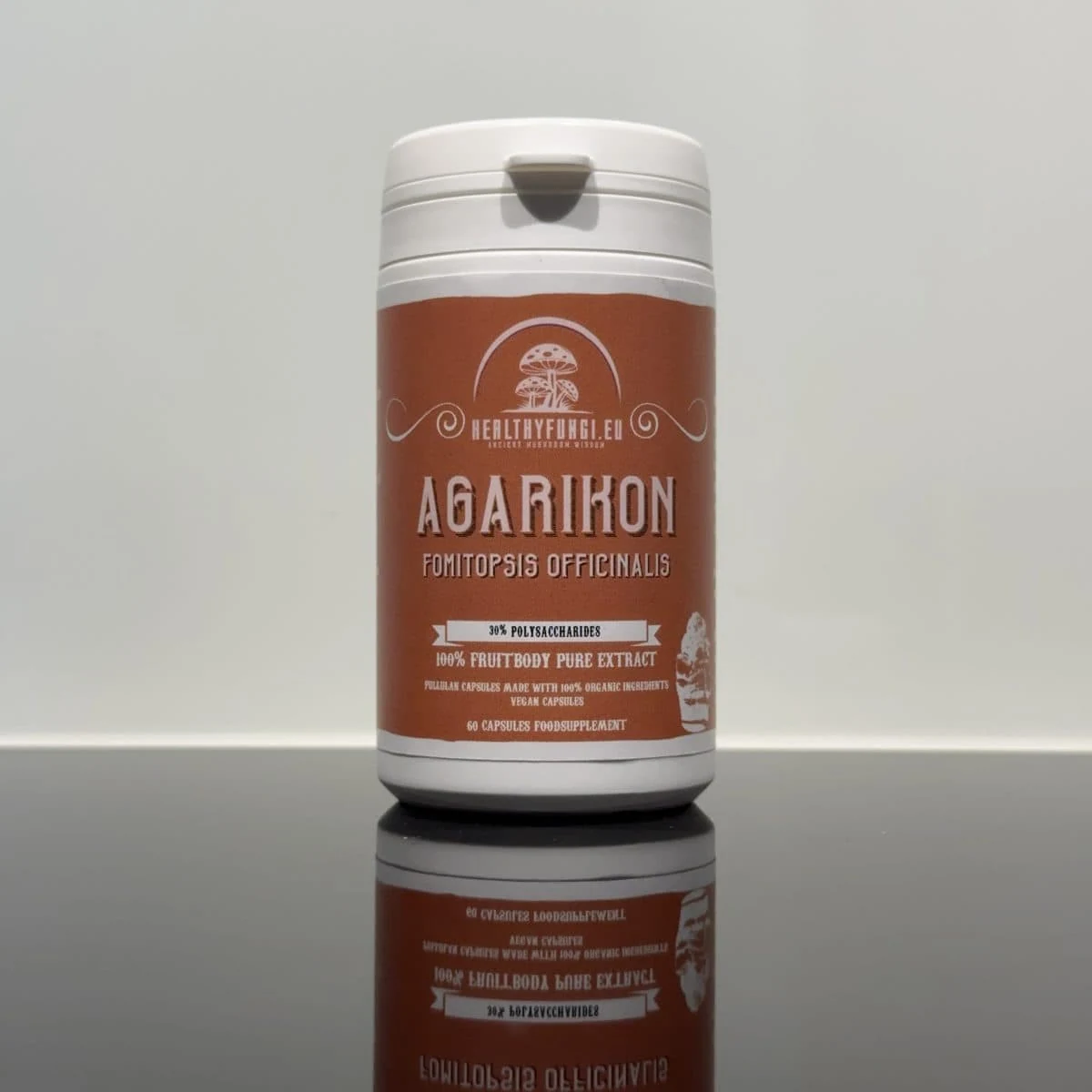
Agarikon's distinctive fruiting bodies grow on trees over many years. This pale, woody bracket fungus has long been known for its pronounced bitter taste. Today we distinguish between the natural mushroom, traditional preparations and the carefully standardized extract.
Raw materialFruiting body
ProcessingFermentation and hot-water extraction
StandardizationAt least 30% polysaccharides
01
A long history
Agarikon holds a special place in ancient European herbal knowledge. In the first century AD, the Greco-Roman physician Pedanius Dioscorides described a fungus known as agarikon or agaricum. His work The Materia Medica remained influential for centuries.
Agarikon also appeared in European apothecary and herbal books of the seventeenth century. In the eighteenth and nineteenth centuries, the dried bracket fungus was traded from Russian forests to Western Europe. This history explains why Agarikon occurs so often in traditional texts, but in itself says nothing about the clinical effects of a modern extract.
02
The legend of Mithridates
There is a well-known tradition surrounding King Mithridates VI of Pontus (132–63 BC) and the creation of complex herbal mixtures. According to ancient accounts, the ruler took a keen interest in poisons and antidotes. His name later became associated with the term mithridatism.
Tradition also associates Agarikon with such unusual preparations. The story belongs to the mushroom's cultural history; there is no reliable historical evidence that Mithridates personally used our present-day Agarikon or that it protects against poisoning.
03
Names and traditional designations
The name currently in use is Laricifomes officinalis. Older mycological literature also includes, among others, Fomitopsis officinalis, Fomes officinalis and Polyporus officinalis . Historical names such as Agaricus albus, white agaric or larch bracket fungus reflect the place of this fungus in the historical herbal trade.
The designation agarikon has been associated in ancient texts with the region of Agaria, while other accounts refer to Agary or Agarus. Because historical names were sometimes used for different tree fungi, reliable botanical species identification remains essential.
04
Growth, origin and nature
Agarikon is a wood-dwelling fungus found mainly on older conifers, particularly larch trees. The species forms large, often pale, hard fruiting bodies and occurs in parts of Eurasia and North America, among other regions. It is closely associated with old-growth forest habitats and grows slowly.
Selecting our fruiting-body material begins with attention to species identity, the cultivation or collection site and the purity of the raw material. For wild-collected Agarikon, careful traceability is also important because natural populations may be vulnerable. The part of the mushroom used for our extract is the fruiting body, not ground-up grain substrate.
05
Natural constituents
Various polysaccharides, including glucan fractions, and secondary metabolites have been found in Agarikon's fruiting body. Scientific literature also describes lanostane-type triterpenoids, sterols and, among other compounds, agaricic acid.
The original mushroom material also contains protein and amino-acid fractions and mineral constituents. Which substances ultimately enter an extract depends on solubility, processing and the analytical method used. A substance detected in the mushroom is not necessarily present in the same quantity in the finished extract.
06
Fermentation and hot-water extraction
For our Agarikon preparation, the fruiting body undergoes a fermentation step followed by hot-water extraction. Warm water extracts mainly water-soluble components from the material. The liquid extract is then concentrated and dried into a powder.
We standardize to at least 30% total polysaccharides, with an average content of around 33–34%. This percentage is not equivalent to a separately measured beta-glucan content. Nor does it indicate how many triterpenoids or other specific compounds the extract contains; separate tests are needed for that.
What does 30% polysaccharides mean?
At a minimum content of 30%, a capsule containing 300–350 mg of extract mathematically provides at least 90–105 mg of constituents measured as total polysaccharides. This is a calculation based on the product specification. It is not a separate beta-glucan measurement or a measure of a proven health effect.